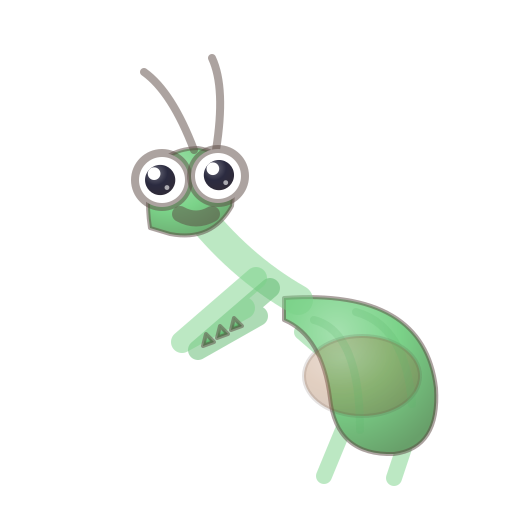
 Praying Mantis vs
 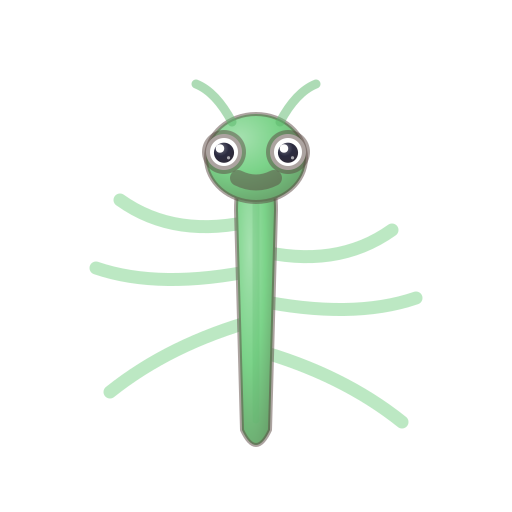 Stick Insect: Which Pet Should You Get?
Torn between a praying mantis and a stick insect? Here's an honest side-by-side look at cost, care time, space, and kid-friendliness — using the same data that powers our pet quiz.
Quick answer: For most families, a stick insect is the easier choice — it needs less experience. Neither is better overall — it comes down to your family's space, time, and budget.
| Praying Mantis | Stick Insect | |
|---|---|---|
| Monthly cost | $5–$15/mo | $5–$15/mo |
| Space needed | Small space | Small space |
| Daily time | A little | A little |
| Cuddle factor | Some cuddles | Some cuddles |
| Handling | Gentle, supervised handling | Gentle, supervised handling |
| Awake when | Awake in the daytime | Night owl |
| Company | Must live alone | Fine alone or paired |
| Experience needed | Some experience | Great first pet |
| Lifespan | under 1 year | 1–2 years |
| Kid-friendly | ★★★☆☆ | ★★★☆☆ |
| Allergy-friendly | ✅ Yes | ✅ Yes |
Choose a praying mantis if…
- you want a pet that's awake when your kid is (the stick insect sleeps through most of the day)
Choose a stick insect if…
- this is your family's first pet
Praying Mantis at a glance
Praying mantises are captivating little hunters — they track you with alien eyes, clean their arms like a cat, and ambush insects in a flash. They're cheap and easy for a short-lived pet, but they only live about a year and are delicate, so they're for watching more than handling.
Stick Insect at a glance
Stick insects (and leaf insects) are amazing camouflage pets — they look exactly like twigs or leaves and move in slow motion. They're cheap, quiet, and easy, eating only fresh leaves. A magical, low-cost first bug for gentle, careful kids.
What really makes them different
Hunter vs leaf-eater
A praying mantis is an active little hunter. It catches and eats live insects like flies and small crickets, so feeding is exciting but means keeping live bugs on hand. A stick insect is a calm vegetarian. It munches leaves like bramble or privet and spends its day holding still, pretending to be a twig. So one puts on a hunting show, and the other is a gentle, slow master of hide-and-seek.
Lifespan and ease
Stick insects are one of the easiest first bugs — slow, gentle, and happy with fresh leaves and a misted enclosure. They live about 1-2 years. A praying mantis is fascinating but short-lived, usually under a year, and it needs a steady supply of live food. Both can be observed up close, and a calm stick insect may walk gently onto a hand. Always move slowly and let the insect choose to climb on.
🧠 Test your knowledge
❓ Common questions
Which lives longer?
Stick insects do — about 1-2 years, while a praying mantis usually lives under a year.
What do they eat?
A mantis eats live insects like flies and crickets. A stick insect eats fresh leaves such as bramble or privet.
Which is easier for a first bug?
A stick insect. It is slow, gentle, and just needs fresh leaves and light misting, with no live prey to manage.
 Ant Farm vs
  Jumping Spider vs