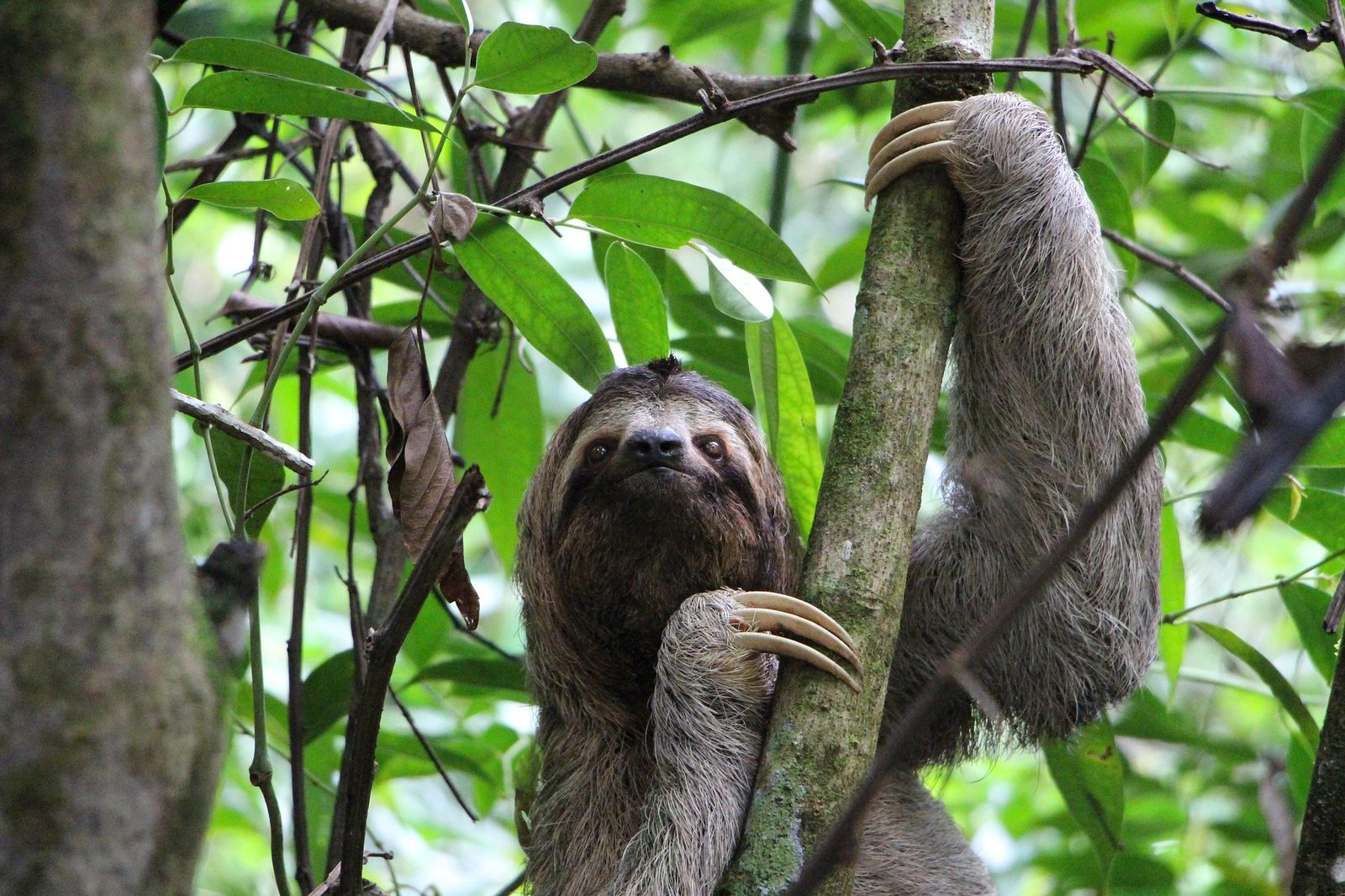
Sloths live life in slow motion, hanging upside-down in rainforest trees and moving only about 40 yards a day. Going slow is actually their superpower: predators like eagles and jaguars simply don't notice them.
📋 Sloth at a glance
⚡ Superpower
Sloths move so slowly that green algae grows in their fur — turning them into living, leafy camouflage.
Where sloths live and how they're built
Sloths live in the rainforests of Central and South America, hanging upside down from branches high in the canopy. Their long curved claws hook over a branch so securely that a sloth can sleep — and even die — without falling. Sloth fur grows the opposite way to other mammals', parting along the belly so rain runs off an upside-down animal, and it is home to a whole tiny world: green algae grows in it, which turns the sloth a leafy colour and hides it from eagles and jaguars.
What sloths eat and why they are so slow
Sloths eat leaves, twigs and a little fruit, and leaves are a poor meal: they take a very long time to digest and give little energy in return. So a sloth does everything slowly to save power — it moves only about 40 yards on a good day, and its body runs cooler than most mammals'. Being slow is not a weakness; it is the whole strategy. A sloth that barely moves is a sloth that predators never notice. The one time it moves faster is in water, where it is a surprisingly good swimmer.
Family life and a weekly trip to the ground
A mother sloth carries her single baby on her chest for months, and the youngster learns which leaves to eat by tasting what she eats. Sloths live alone as adults and are so quiet that they can share a tree for years without much fuss. About once a week a sloth makes a slow, risky climb all the way down to the forest floor to poop, then climbs back up. Most sloth species are listed as least concern, though the ones living in small forest patches are in trouble as those forests are cut.
🤩 6 amazing Sloth facts
Algae grows in sloth fur, giving them a greenish tint that hides them in the trees.
Here is every sloth fact from this page and the sloth quiz in one list — handy for a school project or a car-ride quiz.
- Algae grows in sloth fur, giving them a greenish tint that hides them in the trees.
- Sloths are about 3 times faster in water than on land — surprisingly good swimmers!
- They climb down from their tree only about once a week, to poop.
- A sloth's grip is so strong it can sleep while hanging upside-down.
- Sloths only move about 40 yards a day — slower than a snail marathon.
- Sloths are listed as Least Concern and can live 20 to 30 years.
❓ Common questions about sloths
How big is a sloth?
Up to 17 lb (8 kg). Algae grows in sloth fur, giving them a greenish tint that hides them in the trees.
Where do sloths live?
Sloths live in the wild: rainforests of central & south america. They are wild animals and are never kept as pets.
What do sloths eat?
Sloths are herbivores: leaves, twigs, fruit.
How fast can a sloth move?
About 40 yards per day. Sloths move so slowly that green algae grows in their fur — turning them into living, leafy camouflage.
How long do sloths live?
Sloths typically live 20–30 years.
Can you keep a sloth as a pet?
No — sloths are wild animals that belong in the wild (rainforests of central & south america), and keeping one would be unsafe and usually illegal. The closest pet you can actually keep is a tortoise — see our care guide.
Could you keep a sloth as a pet?
No — sloths are wild animals that belong in the wild, and keeping one would be unsafe and almost always illegal. But if sloths are your favorite, here's the closest pet you actually can welcome home:
 Meet the TortoiseBecause no pet is as slow-and-steady as a sloth, but a tortoise shares that famously laid-back pace.
See care guide →
🎬 See sloths in action
Watch kid-friendly videos about sloths on YouTube.
▶ Watch Sloth videos on YouTube