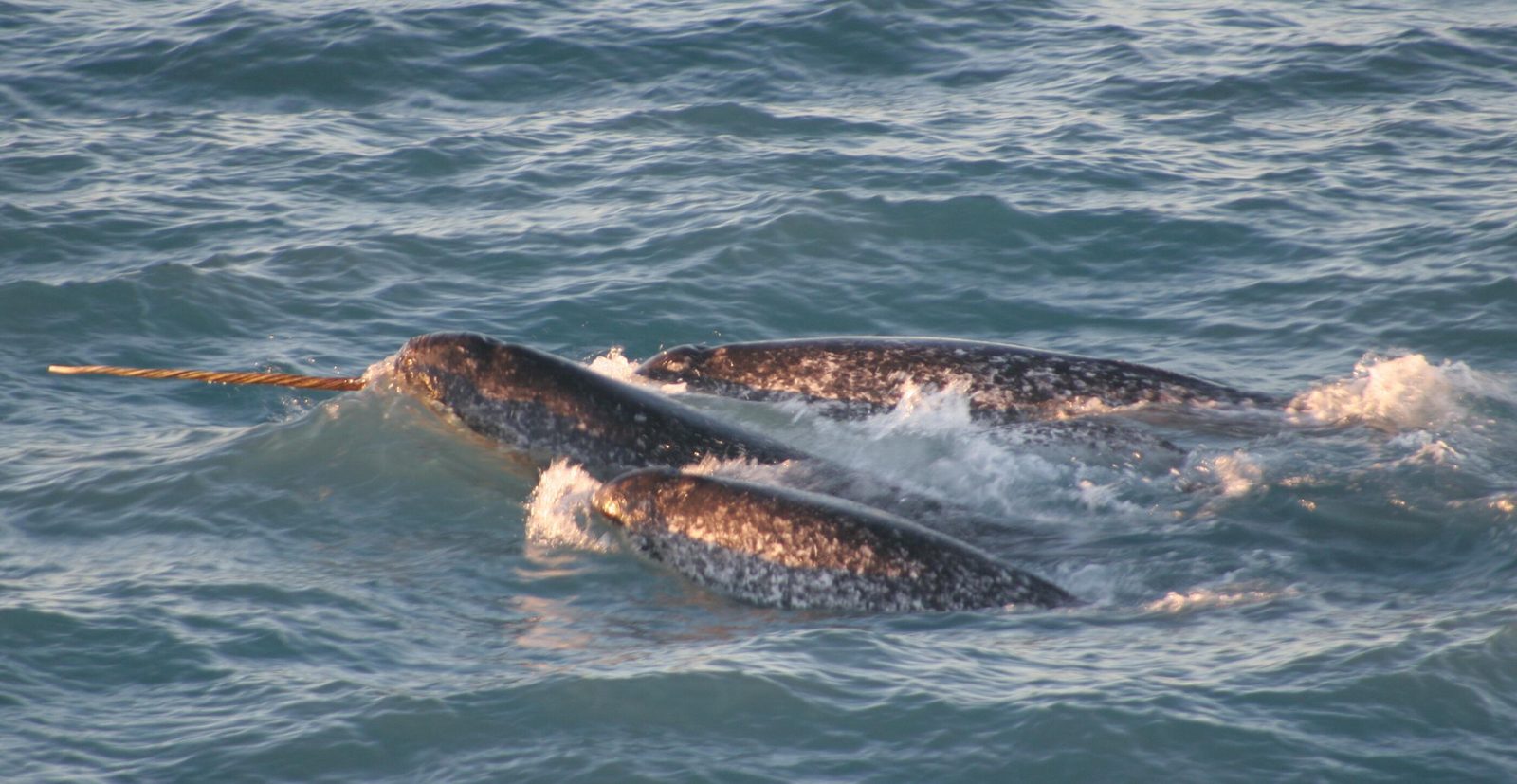
Narwhals are real-life sea unicorns of the Arctic. The long spiral "horn" on males is actually a tooth that grows right through the upper lip — up to 10 feet long — and works like a giant sensor for the icy sea.
📋 Narwhal at a glance
⚡ Superpower
A narwhal's "horn" is really a giant tooth with about 10 million nerve endings that senses the ocean around it.
Where narwhals live and how they're built
Narwhals live in the icy waters of the Arctic, around Greenland and northern Canada, and they never leave the cold. They are medium-sized whales with mottled grey skin and no dorsal fin — a smooth back is easier for sliding under sea ice. The famous spiral tusk is a tooth that grows straight through the upper lip, mostly on males, and can reach 10 feet long. Very rarely a narwhal grows two. The tusk is not a weapon for fighting; it is a sensor packed with millions of nerve endings that reads the water around it.
What narwhals eat and how deep they dive
Narwhals eat fish such as halibut and cod, plus squid and shrimp, and they find much of their food far below the surface. They are champion divers, going down almost a mile and staying under for a long time on a single breath. In winter they hunt in the dark under thick sea ice, keeping track of the few cracks where they can surface to breathe. Like other toothed whales they use clicks and echoes to find prey in water where there is almost no light.
Family life among the ice
Narwhals travel in groups, and in summer hundreds can gather in the same bay, while in winter they spread out under the ice in smaller pods. A mother has one calf at a time and nurses it for well over a year, and the young whale stays close to her, learning the routes between summer and winter waters. Narwhals are listed as least concern, but they live in one of the fastest-changing places on Earth: as the Arctic warms, the ice they hide under and the fish they eat are both on the move.
🤩 6 amazing Narwhal facts
The narwhal's tusk is a tooth that can grow 10 feet long.
Here is every narwhal fact from this page and the narwhal quiz in one list — handy for a school project or a car-ride quiz.
- The narwhal's tusk is a tooth that can grow 10 feet long.
- The tusk has around 10 million nerve endings to sense the water.
- Mostly males grow tusks; a rare few grow two.
- Narwhals are champion divers, reaching depths of almost a mile.
- They live their whole lives in and around Arctic ice.
- A narwhal with two tusks is very unusual and special.
❓ Common questions about narwhals
How big is a narwhal?
Up to 4,200 lb (1,900 kg). The narwhal's tusk is a tooth that can grow 10 feet long.
Where do narwhals live?
Narwhals live in the wild: icy arctic waters. They are wild animals and are never kept as pets.
What do narwhals eat?
Narwhals are carnivores: fish, squid, shrimp.
How fast can a narwhal move?
Dives over 4,900 ft deep. A narwhal's "horn" is really a giant tooth with about 10 million nerve endings that senses the ocean around it.
How long do narwhals live?
Narwhals typically live 30–40 years (some much longer).
Can you keep a narwhal as a pet?
No — narwhals are wild animals that belong in the wild (icy arctic waters), and keeping one would be unsafe and usually illegal. The closest pet you can actually keep is a fish — see our care guide.
Could you keep a narwhal as a pet?
No — narwhals are wild animals that belong in the wild, and keeping one would be unsafe and almost always illegal. But if narwhals are your favorite, here's the closest pet you actually can welcome home:
 Meet the FishBecause no pet is a narwhal, but a home aquarium lets you keep and watch amazing underwater life up close.
See care guide →
🎬 See narwhals in action
Watch kid-friendly videos about narwhals on YouTube.
▶ Watch Narwhal videos on YouTube