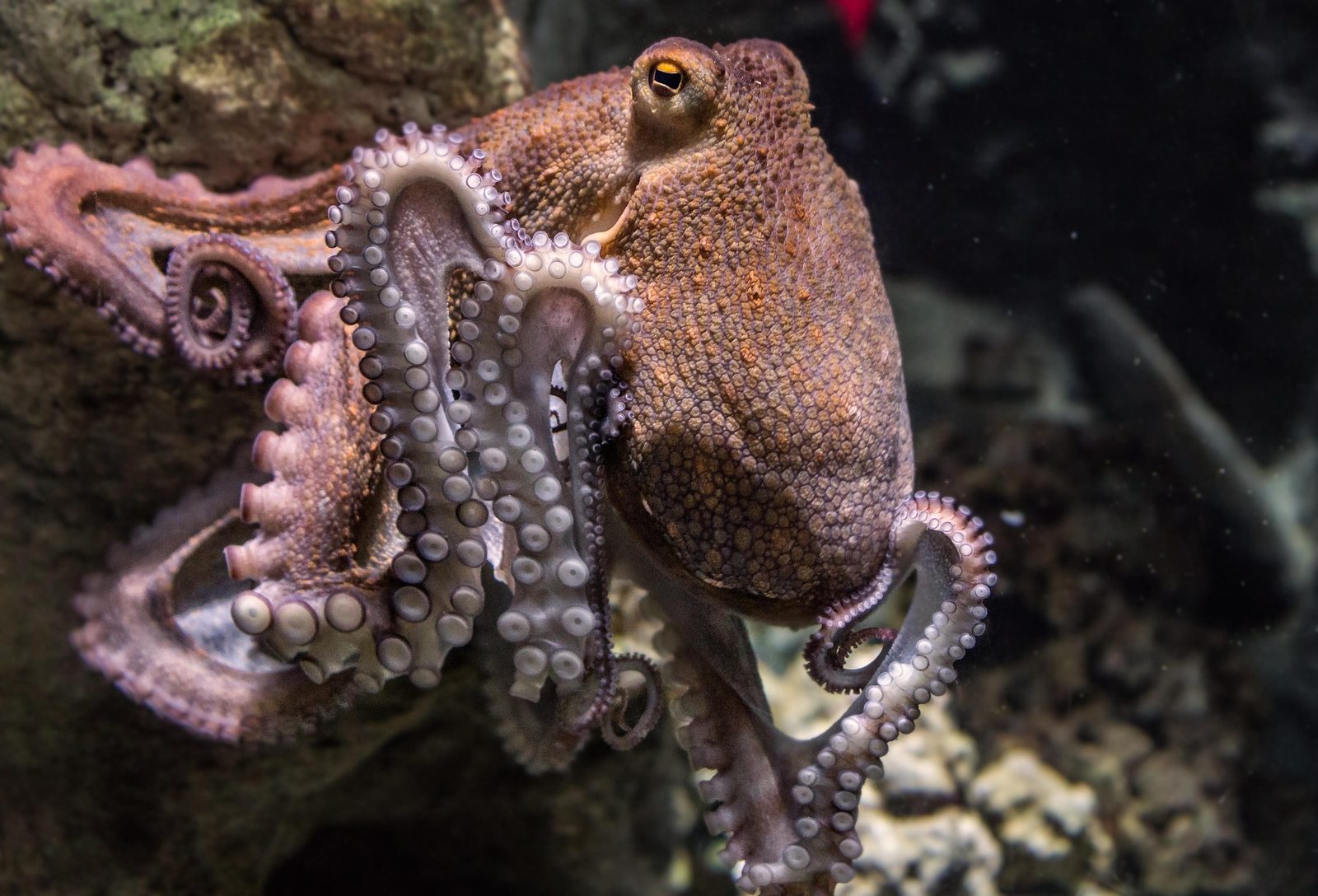
Octopuses might be the closest thing Earth has to aliens: three hearts, blue blood, no bones, and a mini-brain in each of their eight arms. They solve puzzles, open jars, carry coconut shells as armor, and disappear with instant camouflage.
📋 Octopus at a glance
⚡ Superpower
An octopus can change its color AND texture in less than a second to vanish against any background.
Where octopuses live and how they're built
Octopuses live in every ocean, from shallow coral reefs and rocky tide pools to the cold deep sea. They are molluscs, relatives of snails and clams, but they gave up the shell long ago. An octopus has eight arms lined with suckers, three hearts, blue blood, and no bones at all, so it can pour itself through any gap bigger than its hard beak — the only solid part of its body. Its skin is full of tiny colour cells that it can open and close in a blink, changing colour and even texture to match a rock or a patch of weed.
How an octopus hunts and hides
Octopuses eat crabs, clams, shrimp and small fish. They hunt mostly at night, feeling into cracks with their arms, and they can bite through a crab's shell with their beak. Between hunts an octopus hides in a den and may build a wall of rocks across the doorway. Some carry coconut shells or clam shells across the seabed to use as a portable shelter, which counts as using a tool. If a predator grabs an arm, the octopus can let it go and grow a new one, and it can squirt a cloud of ink to cover its escape.
A short, clever life
Octopuses are among the smartest animals without a backbone: in aquariums they learn to open jars, recognise individual keepers and solve puzzles for food. Each arm has its own bundle of nerves and can taste and explore on its own. Most octopuses live only one to five years. A female lays thousands of eggs in her den and guards them without eating until they hatch, and she dies soon after. The tiny babies drift off with the plankton and have to learn everything for themselves. Most octopus species are listed as least concern.
🤩 8 amazing Octopus facts
An octopus has three hearts and blue blood.
Here is every octopus fact from this page and the octopus quiz in one list — handy for a school project or a car-ride quiz.
- An octopus has three hearts and blue blood.
- Besides its main brain, each of its 8 arms has its own mini "brain" of nerves.
- With no bones, an octopus can squeeze through a hole the size of its beak.
- Octopuses use tools — some carry coconut shells around as portable hideouts.
- They can change color and skin texture in under a second.
- Using tools shows just how smart octopuses really are.
- A giant Pacific octopus can have an arm span up to 16 feet!
- Most octopus species live only about 1 to 5 years.
❓ Common questions about octopuses
How big is an octopus?
Giant Pacific: arm span to 16 ft. An octopus has three hearts and blue blood.
Where do octopuses live?
Octopuses live in the wild: oceans worldwide, from reefs to the deep sea. They are wild animals and are never kept as pets.
What do octopuses eat?
Octopuses are carnivores: crabs, clams, shrimp.
How fast can an octopus move?
Changes color in a blink. An octopus can change its color AND texture in less than a second to vanish against any background.
How long do octopuses live?
Octopuses typically live 1–5 years (most species).
Can you keep an octopus as a pet?
No — octopuses are wild animals that belong in the wild (oceans worldwide, from reefs to the deep sea), and keeping one would be unsafe and usually illegal. The closest pet you can actually keep is a fish — see our care guide.
Could you keep an octopus as a pet?
No — octopuses are wild animals that belong in the wild, and keeping one would be unsafe and almost always illegal. But if octopuses are your favorite, here's the closest pet you actually can welcome home:
 Meet the FishBecause a pet octopus is only for expert aquarists, but a beginner aquarium is a wonderful window into aquatic life.
See care guide →
🎬 See octopuses in action
Watch kid-friendly videos about octopuses on YouTube.
▶ Watch Octopus videos on YouTube