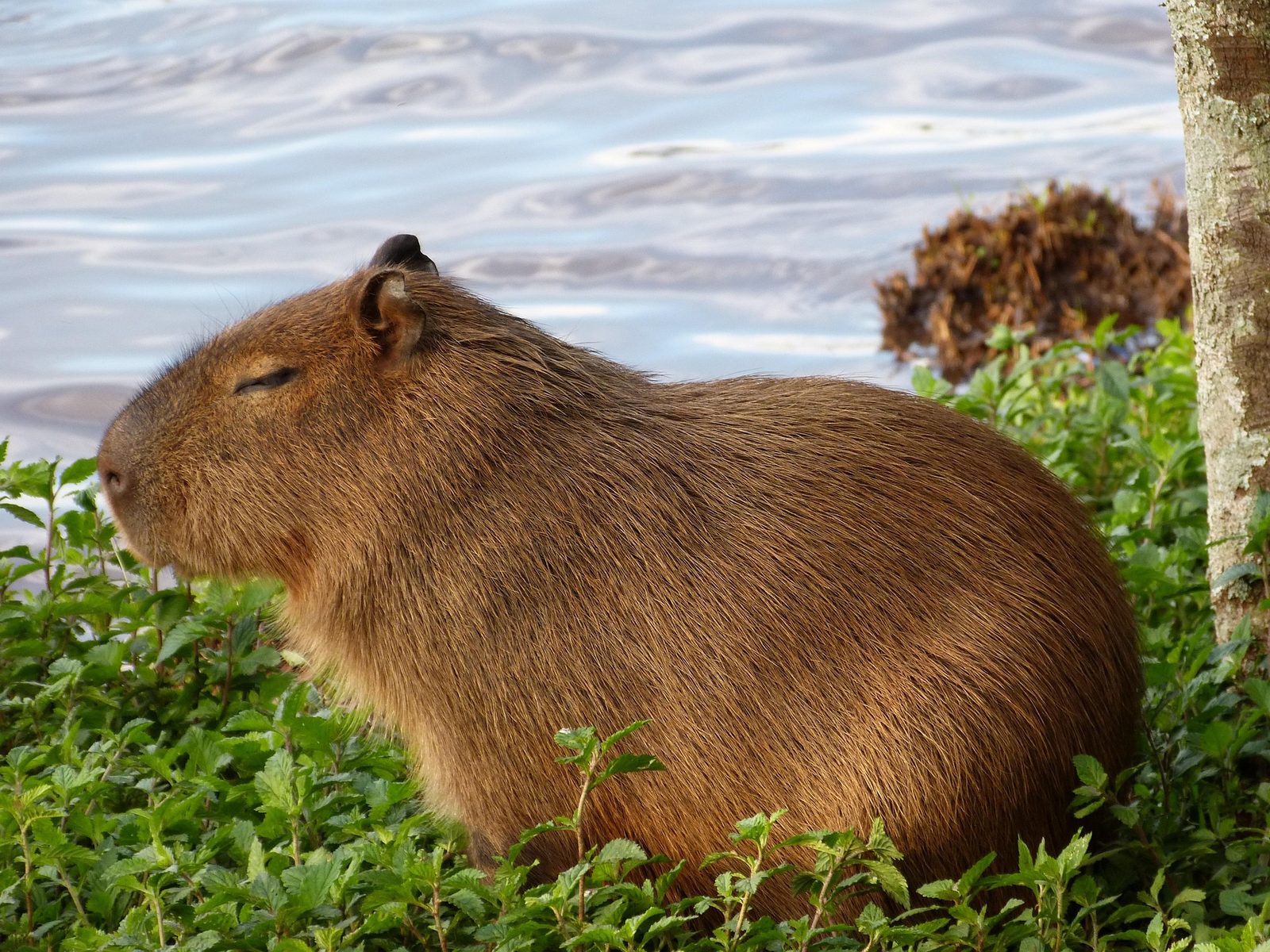
Capybaras look like guinea pigs that drank a growth potion — they're the largest rodents on Earth. They lounge in groups by rivers, swim like pros, and are famously relaxed: other animals literally sit on them.
📋 Capybara at a glance
⚡ Superpower
Capybaras are so calm that birds, monkeys, and even turtles use them as comfy benches.
Where capybaras live and how they're built
Capybaras live along rivers, lakes and marshes across South America, and they are the largest rodents on Earth — a big one weighs as much as a large dog. They look like giant guinea pigs, which makes sense, because guinea pigs are their close relatives. A capybara is built for a life half in the water: its toes are partly webbed, its coarse fur dries fast, and its eyes, ears and nostrils sit on top of its head so it can float almost fully hidden with just the top of its face showing.
What capybaras eat
Capybaras are grazers, eating grasses and water plants for hours at a time, mostly in the morning and evening. Like rabbits and guinea pigs, they digest their food twice, eating some of their own droppings to get every last bit of goodness from tough grass. When danger comes — a jaguar, a caiman, an anaconda — a capybara gives a bark of alarm and the whole group plunges into the water, where it can hold its breath for around 5 minutes and swim away.
Family life: the calmest animals on the riverbank
Capybaras live in friendly groups of 10 to 20, and in the dry season, when water is scarce, groups can swell to 100 animals around the last pools. A dominant male watches over the group, and the females raise their young together — a baby capybara will nurse from any mother in the herd. They are famous for their calm: birds, monkeys and even turtles sit on them, and capybaras simply let them. Capybaras are listed as least concern and are doing well across most of their range.
🤩 6 amazing Capybara facts
Capybaras are the world's largest rodents — up to 150 lb.
Here is every capybara fact from this page and the capybara quiz in one list — handy for a school project or a car-ride quiz.
- Capybaras are the world's largest rodents — up to 150 lb.
- They can hold their breath underwater for about 5 minutes.
- Their eyes, ears, and nose sit on top of their head so they can hide almost fully underwater.
- Capybaras are famously chill — birds and monkeys ride on them like a bus.
- They live in friendly groups of 10–20 (sometimes up to 100 in the dry season).
- Capybaras are listed as Least Concern, so they are doing well in the wild.
❓ Common questions about capybaras
How big is a capybara?
Up to 150 lb (68 kg). Capybaras are the world's largest rodents — up to 150 lb.
Where do capybaras live?
Capybaras live in the wild: riversides & wetlands of south america. They are wild animals and are never kept as pets.
What do capybaras eat?
Capybaras are herbivores: grasses, water plants.
How fast can a capybara move?
Holds its breath 5 minutes. Capybaras are so calm that birds, monkeys, and even turtles use them as comfy benches.
How long do capybaras live?
Capybaras typically live 8–10 years.
Can you keep a capybara as a pet?
No — capybaras are wild animals that belong in the wild (riversides & wetlands of south america), and keeping one would be unsafe and usually illegal. The closest pet you can actually keep is a guinea pig — see our care guide.
Could you keep a capybara as a pet?
No — capybaras are wild animals that belong in the wild, and keeping one would be unsafe and almost always illegal. But if capybaras are your favorite, here's the closest pet you actually can welcome home:
 Meet the Guinea PigBecause a capybara is basically a giant guinea pig — and a guinea pig gives you the same gentle, chatty charm in a pet-sized package.
See care guide →
🎬 See capybaras in action
Watch kid-friendly videos about capybaras on YouTube.
▶ Watch Capybara videos on YouTube