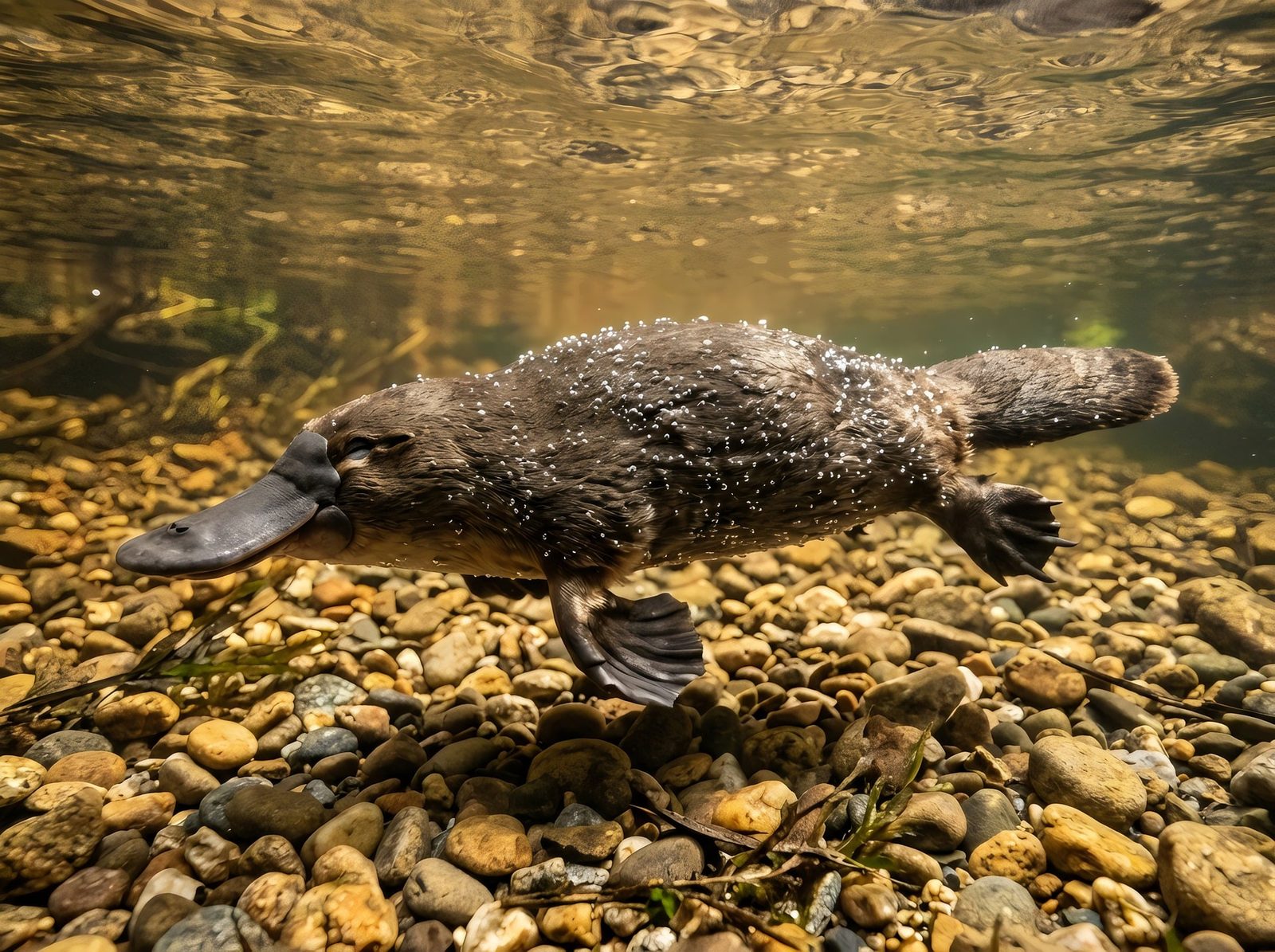
When scientists first saw a platypus, they thought it was a prank — a furry mammal with a duck's bill, webbed feet, and a beaver-like tail that lays EGGS. Its bill is packed with sensors that detect the electricity made by wiggling prey underwater.
📋 Platypus at a glance
⚡ Superpower
A platypus hunts with its eyes, ears, and nose shut — its rubbery bill senses the tiny electric signals of its prey.
Where platypuses live and how they're built
Platypuses live in the rivers, streams and lakes of eastern Australia, and there is nothing else quite like them. A platypus is a mammal with fur and milk, yet it lays eggs, has a rubbery duck-like bill, webbed feet and a flat tail like a beaver's. When the first specimen reached scientists in Europe, some thought it was a hoax stitched together from different animals. Males even carry a venomous spur on each back ankle. Its dense fur traps a layer of air so the animal stays warm and dry underwater.
How a platypus hunts with its eyes shut
A platypus closes its eyes, ears and nostrils when it dives, and hunts entirely with its bill. The bill is packed with sensors that pick up the tiny electric signals made by a shrimp or an insect larva twitching in the mud, and the platypus sweeps its head from side to side to home in on them. It stuffs its catch into cheek pouches and comes to the surface to grind it up — a platypus has no teeth as an adult, and no stomach either, so food goes straight through to the gut.
Family life in a riverbank burrow
A female platypus digs a long burrow into a riverbank and lays her eggs at the end of it, curling around them to keep them warm. The babies that hatch are tiny and helpless, and they drink milk that seeps through the skin of their mother's belly, because a platypus has no teats. Young platypuses stay in the burrow for months before they take their first swim. Platypuses are listed as near threatened: drought, dams and polluted rivers have shrunk the places they can live.
🤩 8 amazing Platypus facts
The platypus is one of only a few mammals on Earth that lay eggs.
Here is every platypus fact from this page and the platypus quiz in one list — handy for a school project or a car-ride quiz.
- The platypus is one of only a few mammals on Earth that lay eggs.
- Its bill senses electricity from prey — it hunts with eyes, ears, and nostrils closed.
- Male platypuses have a venomous spur on each back ankle.
- Platypuses have no stomach — food goes straight to their gut.
- Platypus fur glows blue-green under ultraviolet (UV) light.
- Most mammals give birth to live babies instead of laying eggs.
- Healthy rivers help keep platypus populations safe.
- Scientists only discovered this glowing fur fairly recently.
❓ Common questions about platypuses
How big is a platypus?
Up to 20 in (50 cm) long. The platypus is one of only a few mammals on Earth that lay eggs.
Where do platypuses live?
Platypuses live in the wild: rivers & streams of eastern australia. They are wild animals and are never kept as pets.
What do platypuses eat?
Platypuses are carnivores: insect larvae, shrimp, worms.
How fast can a platypus move?
Hunts with its eyes closed. A platypus hunts with its eyes, ears, and nose shut — its rubbery bill senses the tiny electric signals of its prey.
How long do platypuses live?
Platypuses typically live ~12 years in the wild.
Can you keep a platypus as a pet?
No — platypuses are wild animals that belong in the wild (rivers & streams of eastern australia), and keeping one would be unsafe and usually illegal. The closest pet you can actually keep is an axolotl — see our care guide.
Could you keep a platypus as a pet?
No — platypuses are wild animals that belong in the wild, and keeping one would be unsafe and almost always illegal. But if platypuses are your favorite, here's the closest pet you actually can welcome home:
 Meet the AxolotlBecause no pet is as odd-and-wonderful as a platypus, but for a strange, aquatic, watch-in-wonder animal an axolotl is perfect.
See care guide →
🎬 See platypuses in action
Watch kid-friendly videos about platypuses on YouTube.
▶ Watch Platypus videos on YouTube